


First Distributed PV Power Station in the Chlor-Alkali Industry Connected to Grid: Dezhou Shihua BIPV Project Sets a New Benchmark for "Chemical Industry + Photovoltaics"
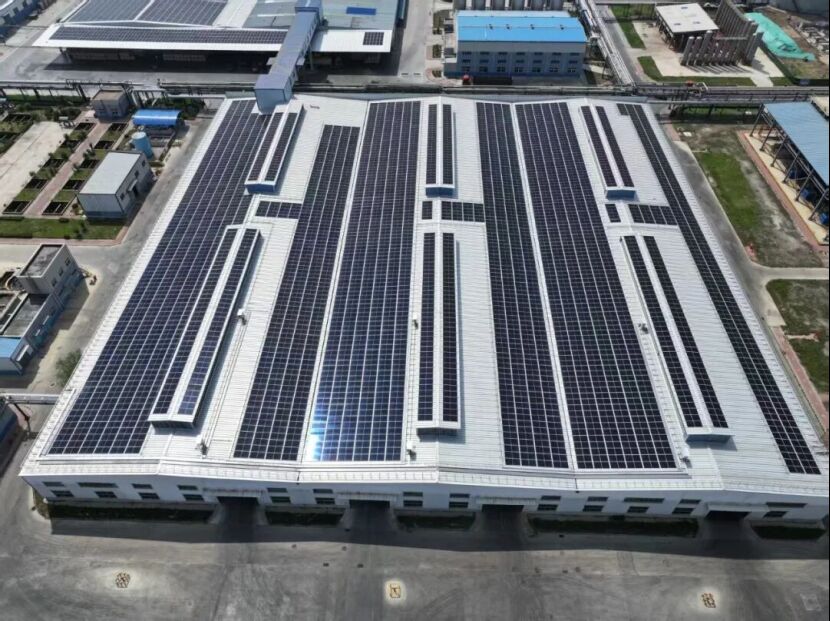
Recently, the 8.9557MWp distributed PV power generation project of Dezhou Shihua was successfully connected to the grid, implemented via the LONGi-CENTER INT BIPV solution. As the first completed and operational distributed PV power station in China’s chlor-alkali sector, the project marks a major breakthrough in clean energy development for Sinochem’s Chlor-Alkali Division, and opens a new low-carbon transformation pathway for high-energy-consuming chemical enterprises.
Evolving from Dezhou Petrochemical Plant founded in 1971 to a wholly-owned subsidiary of Sinochem’s Chlor-Alkali Division, Dezhou Shihua has demonstrated its determination and capacity to transform from a traditional chemical enterprise toward green low-carbon development over half a century of persistence and innovation.
Located within Dezhou Shihua Chemical Co., Ltd.’s production zone in Dezhou City, Shandong Province, the project leverages roof resources across 20 existing factory buildings including office buildings, PVC warehouses and electrical instrument warehouses, adopting LONGi-CENTER INT BIPV 5.0 with a total installed capacity of 8.9557MWp. Operating under a full self-consumption model, 100% of the generated clean power supplies the company’s manufacturing operations, with an estimated annual power output of approximately 9.85 million kWh.
In terms of environmental benefits, the project saves around 3,000 tons of standard coal annually, cuts CO₂ emissions by 8,100 tons and sulfur dioxide emissions by 0.758 tons per year, equivalent to planting roughly 4,500 trees. As a national-level Green Factory, Dezhou Shihua further consolidates its foundation for green development through this project, continuously practicing low-carbon production concepts.
2026 witnessed major policy adjustments for China’s distributed PV sector: the National Energy Administration officially abolished the mandatory restriction limiting transformer reverse load rate to 80%, and all new energy grid-connected power is fully integrated into the electricity market. Against this backdrop, the project’s design of full self-consumption and on-site power absorption aligns deeply with new policy guidance: it avoids reliance on grid connection channels and does not increase grid load, realizing precise matching between clean power output and production power demand.
In recent years, CENTER INT has continuously delivered standardized BIPV implementation systems adapted to chemical industry scenarios, reconstructing green carriers starting from factory building foundations to promote large-scale rollout of on-site power self-consumption models across industries. The integrated "chemical industry + clean energy" development model pioneered by this project provides a replicable and promotable demonstration benchmark for chlor-alkali enterprises nationwide and the broader chemical sector to activate idle roof resources and implement green low-carbon renovations.

 Tel: +86 010-67856668
 Sales & Service:4000-603098
 Email: marketing@centerint.com


Copyright 2026 CENTER INT GROUP | All Rights Reserved 京ICP备09099836号-2