


PV Domes Rise Along the East China Sea: The New Green Chapter of Beilun Power Plant
With an installed capacity of 7.34 million kW securing power supply for Zhejiang and the Yangtze River Delta, China’s largest thermal power plant is shifting its focus from coal piles to sunlight. Recently, the distributed PV project on No.9 Coal Shed of Guoneng Beilun Power Plant was successfully connected to the grid. Covering a 49,000 sq.m arched roof with 6.4MW solar panels, multi-energy complementarity is gradually turning from blueprint into reality.
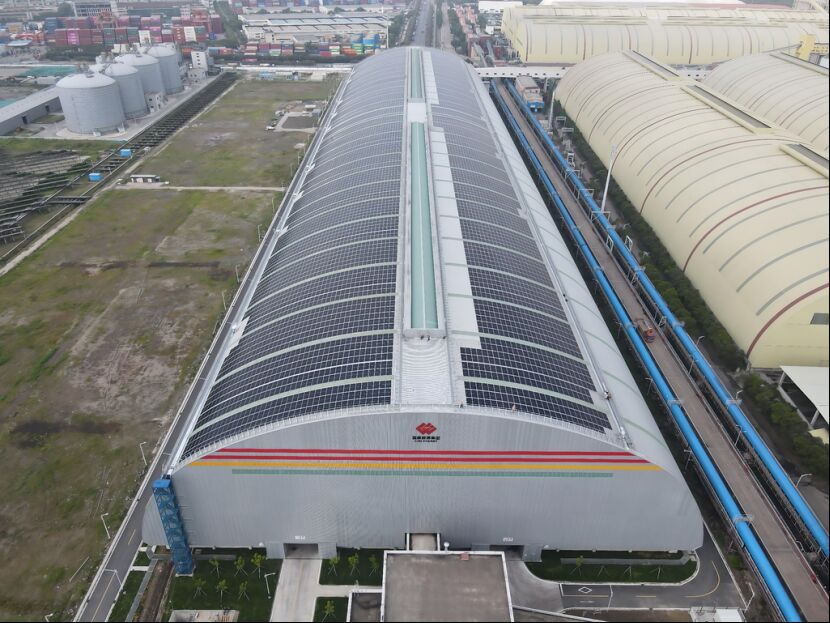
Guoneng (Zhejiang Beilun) Power Generation Co., Ltd., affiliated with China Energy Investment Corporation, operates China’s largest thermal power plant by installed capacity, strongly supporting electricity supply stability in Zhejiang and the Yangtze River Delta. In recent years, Beilun Power Plant has accelerated its transformation from a traditional thermal power plant into an integrated multi-energy base combining thermal, wind, solar and energy storage. The plant has already built 47,500kW PV capacity and 12,500kW wind power capacity, paired with supporting energy storage units. The No.9 Coal Shed distributed PV project serves as a critical step to complete its three-dimensional PV scenario layout.
The No.9 enclosed coal shed of Beilun Power Plant adopts a space truss structure with square pyramid bolted spherical joints, stretching 445 meters in total length, 110 meters in span width and 40.95 meters at maximum height, offering a usable arched roof area of 49,000 sq.m.
The project plans a DC installed capacity of 6.4032MW and AC installed capacity of 5.10MW, with 9,852 pieces of 650Wp monocrystalline silicon solar modules installed on the roof, adopting the LONGi-CENTER INT BIPV (Building Integrated Photovoltaics) construction solution.
The project operates under a full self-consumption model with on-site power absorption, generating an average of 5.8791 million kWh of green power annually and over 160 million kWh total power generation over its 25-year operation period. The integrated BIPV structure combines building materials, thermal insulation and power generation functions, saving approximately 1,778.43 tons of standard coal each year and cutting CO₂ emissions by 3,219.1 tons annually, alongside reduced emissions of sulfur dioxide, nitrogen oxides and dust. The system consumes zero water and produces no wastewater, requiring no additional construction land, and coordinates with ultra-low emission thermal power systems to jointly cut pollution and carbon footprints. Full on-site consumption reduces external electricity purchase costs, while BIPV replaces traditional roof materials to save construction and maintenance expenses, delivering stable long-term returns over 25 years. It also helps the enterprise meet energy consumption and new energy installed capacity assessment targets, realizing both cost reduction and efficiency improvement.
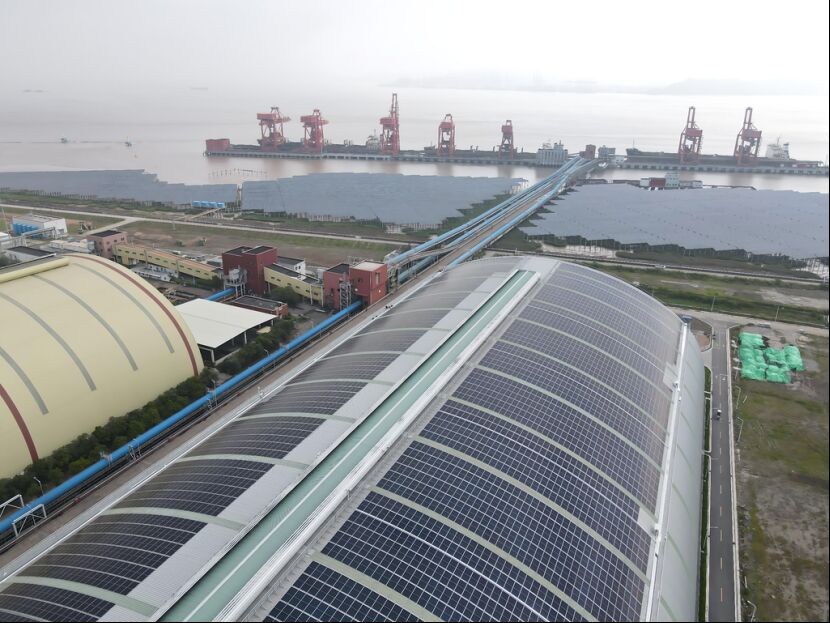
Operating under harsh high-dust and strict fire prevention conditions of coal yards, the LONGi-CENTER INT BIPV Longding system undergoes systematic design across four dimensions: materials, structure, electrical engineering and operation & maintenance:
It passes Class A fire resistance testing, utilizing non-combustible materials for the entire structure to eliminate fire risks at the source;
Long continuous roof panels with flexible connections and refined designs for ridges, openings and gutters ensure full waterproof performance in rainy and snowy weather;
The integrated design delivers a positive bearing capacity of 8.1kPa to withstand hail and other extreme weather;
It achieves a wind resistance rating of 11.2kPa, capable of resisting typhoons above Grade 17.
Tailored to the varying curvature radii of arched coal sheds, LONGi-CENTER INT adopts a slope-following laying scheme balancing rigid protection and flexible adaptation, ensuring structural safety while fitting curved roof surfaces. The construction phase leverages new UAV hoisting technology to break limitations of traditional construction methods, enabling efficient and precise installation on complex curved surfaces. Supporting facilities including high-altitude maintenance walkways, automatic dust washing sprinkler systems, two 25.5-meter steel staircases, coal shed ventilation windows and mid-height maintenance channels are equipped to guarantee long-term safe and stable operation.
The significance of the No.9 Coal Shed PV project extends far beyond a single power station. It unlocks value from idle factory space without occupying new land, completing the plant’s thermal-wind-solar-storage multi-energy complementary system.
Notably, LONGi and CENTER INT jointly compiled the Technical Specification for Crystalline Silicon Module BIPV on Metal Structure Curved Roofs, filling the domestic standard gap for integrated solutions combining curved surfaces, crystalline silicon and metal envelope systems. This means arched coal shed BIPV transformation is no longer a one-off customized case, but a replicable and promotable standardized pathway. With outstanding performance in safety, maintenance, cost and power generation, LONGi-CENTER INT BIPV delivers the optimal solution for green renovation of arched coal sheds.
Across the country, thermal power plants are accelerating transformation into comprehensive energy bases, with coal shed BIPV emerging as a mainstream low-carbon implementation pathway. The solar panels laid atop Beilun Power Plant’s coal shed deliver not only clean electricity, but also chart the future green transformation roadmap for the thermal power industry.

 Tel: +86 010-67856668
 Sales & Service:4000-603098
 Email: marketing@centerint.com


Copyright 2026 CENTER INT GROUP | All Rights Reserved 京ICP备09099836号-2